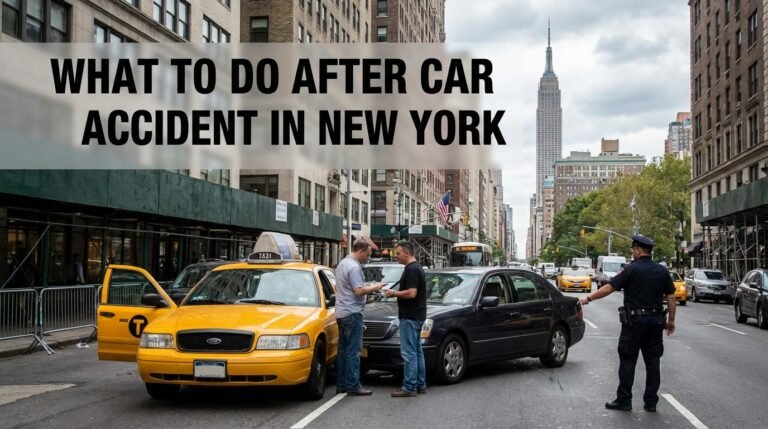
Can You Move Your Car After an Accident in NY?
Can You Move Your Car After an Accident in NY?
Meta Description: Wondering if you can move your car after an accident in NY? Learn New York’s rules, when moving is required, and how to protect your legal rights at the scene.
Focus Keyphrase: move your car after an accident in NY
URL Slug: /can-you-move-your-car-after-accident-ny
Internal Linking Suggestions:
- “how to document injuries after a car accident in New York” → link to your documentation guide
- “what happens if the other driver refuses to share information” → link to your information refusal article
- “statute of limitations for NY car accident claims” → link to your NY filing deadline post
Introduction
You’ve just been in a car accident. Your vehicle is sitting in the middle of the road — or blocking a lane — and drivers behind you are honking. Someone tells you to move your car. Someone else tells you not to touch anything until the police arrive.
So which is it? Can you move your car after an accident in NY — or should you leave everything exactly where it is?
This is a genuinely confusing question, and getting the answer wrong can have real consequences. Moving your car at the wrong time could affect your insurance claim or legal case. But failing to move it when required could put you and others in danger — and even result in a traffic violation.
This guide clears up the confusion with straightforward answers based on New York law.
What New York Law Says About Moving Your Car
New York has a specific law that addresses this situation directly. Under New York Vehicle and Traffic Law § 1144-a, drivers involved in a collision that results only in property damage — with no injuries — are required to move their vehicles to the nearest safe location if the vehicles are obstructing traffic.
You read that right. In certain situations, New York law doesn’t just allow you to move your car — it requires it.
Failing to move your vehicle when legally required to do so could result in a traffic violation. The law was put in place to reduce secondary accidents caused by stalled or stopped vehicles blocking active roadways.
So the idea that you must never move your car after any accident — no matter what — is simply a myth in New York.
When You Should Move Your Car in New York
There are several situations where moving your vehicle is not only acceptable but the right thing to do.
When There Are No Injuries
If the accident involves only property damage — meaning no one is hurt — and your vehicle is drivable, New York law generally expects you to move it out of traffic to a safe location. This could be:
- The shoulder of the road
- A nearby parking lot
- A side street
- Any safe area off the main roadway
This keeps traffic moving, reduces the risk of additional collisions, and is consistent with what New York law requires.
When Your Vehicle Is Creating a Hazard
Even if you’re not sure whether injuries are involved, if your car is sitting in a dangerous position — blocking a lane on a highway, stopped in the middle of an intersection, or positioned in a way that could cause other drivers to crash — moving it to safety makes practical sense.
A secondary accident caused by a blocked roadway can be far more serious than the original collision. Your safety and the safety of others on the road takes priority.
When You Are on a Highway or High-Speed Road
On highways and expressways, remaining stopped in or near active lanes of traffic is especially dangerous. If your vehicle can be driven and there’s a safe place to pull over, do so quickly. Then exchange information and wait for police from the safer location.
When You Should NOT Move Your Car
There are also important situations where moving your car is the wrong call.
When Someone Is Injured
If anyone — in your vehicle, the other vehicle, or elsewhere — appears to be injured, do not move your car until emergency services arrive and assess the situation.
Moving vehicles after an injury accident can disturb physical evidence that may be critical to determining fault. It can also potentially worsen the condition of an injured person if the vehicles are entangled or if emergency responders need the scene preserved.
Call 911 immediately. Let police and medical personnel guide what happens next.
When the Vehicles Cannot Be Safely Driven
If your car is severely damaged, has a flat tire, or can’t be steered safely, don’t attempt to move it. Turn on your hazard lights, set up flares or warning triangles if you have them, and move yourself to a safe location away from traffic while waiting for help.
When Police Have Instructed You Not to Move
If law enforcement officers are already on the scene and have told you to leave the vehicles in place, follow their instructions. They may be preserving the scene for accident reconstruction purposes or other investigative reasons.
The Balance Between Legal Obligation and Evidence Preservation
Here’s where things get nuanced. New York law may require you to move your car in certain situations — but moving it can also disturb evidence that helps establish how the accident happened.
So how do you balance these two concerns?
Document Before You Move
If you do need to move your vehicle — or believe you’re about to — take thorough photos and videos first. Do this as quickly as possible before moving anything.
Capture:
- The exact position of both vehicles relative to each other
- The point of impact and visible damage
- Skid marks or debris on the road
- Traffic signs, signals, and road markings in the area
- The surrounding scene from multiple angles
Even 60 seconds of thorough smartphone photography can preserve crucial evidence before vehicles are moved. This documentation can be just as useful as the original vehicle positions when it comes to establishing fault later.
Mark the Positions If Possible
If you have chalk, paint, or anything that can mark the road surface, consider marking the tire positions before moving. This is rarely practical in real life, but if time and conditions allow, it can preserve positional evidence.
In most cases, thorough photography is sufficient.
What to Do After Moving Your Vehicle
Once you’ve moved to a safe location, don’t assume the situation is under control. There are several important steps to take next.
Stay at the Scene
Moving your car to a safe location is not the same as leaving the scene. You are still legally required to remain nearby, exchange information with the other driver, and wait for police if they’ve been called.
Leaving the scene of an accident entirely — even after moving your car to safety — can constitute a hit-and-run under New York law. The consequences can be serious.
Exchange Information With the Other Driver
Whether you moved your car or not, you need to exchange the following with every driver involved:
- Full name and contact information
- Driver’s license number
- Vehicle registration information
- Insurance company name and policy number
- License plate number
In New York, this is a legal requirement under Vehicle and Traffic Law § 600.
Call the Police
In New York, you are required to report any accident involving injury, death, or property damage exceeding $1,000 to the police. Given that car repairs frequently exceed this threshold, calling the police after most accidents is advisable.
A police report creates an official record of the incident — including the road positions as described by officers or witnesses — which can be important for your insurance claim and any legal proceedings.
File a Report With the DMV
New York also requires drivers to file an MV-104 form (Report of Motor Vehicle Accident) with the Department of Motor Vehicles within 10 days of an accident if it resulted in injury, death, or property damage over $1,000.
Failing to file this form can result in license suspension. Keep this deadline in mind.
How Moving Your Car Can Affect Your Insurance Claim
Insurance companies investigate accident scenes based on available evidence — including vehicle positions, damage patterns, and physical marks on the road. If your car has been moved before an adjuster or investigator sees the scene, some of that evidence may be gone.
This is rarely a reason to refuse to move your car when legally required to do so. But it does reinforce why documentation before moving is so important.
If your car was moved before you had a chance to document the scene — perhaps because emergency responders moved it — note that in your account of the incident. Tell your attorney and your insurer clearly: “The vehicles were moved before I could photograph them because…”
Context matters. An honest, documented explanation of why positions changed is far better than no explanation at all.
Special Situations to Know About
Accidents in Parking Lots
Parking lot accidents in New York are common and create their own set of questions. In a private parking lot, the same general principles apply — you should move your vehicle if it’s safe and no one is injured, exchange information, and document the scene.
However, police may not always respond to private property accidents. Filing an insurance claim and keeping your own documentation becomes even more important in these situations.
Multi-Vehicle Accidents
In accidents involving three or more vehicles, the situation becomes more complex. Multiple parties, potentially conflicting accounts, and more complicated damage patterns mean that documentation is even more critical.
If you’re involved in a multi-vehicle crash, move only if it’s safe and legally required — and document extensively before doing so.
Accidents Involving Cyclists or Pedestrians
If a cyclist or pedestrian is involved in the accident, treat it as an injury accident unless you know with certainty that no one is hurt. Do not move your vehicle. Call 911 immediately and remain at the scene.
Frequently Asked Questions (FAQ)
1. Is it illegal to move your car after an accident in New York?
Not necessarily — in fact, in some cases it’s required. New York Vehicle and Traffic Law § 1144-a requires drivers to move their vehicles out of traffic when an accident results only in property damage and the vehicle is operable. The key exception is when someone is injured — in that case, you should generally leave vehicles in place until police and emergency responders arrive.
2. Do I have to call the police after every car accident in New York?
Not for every minor fender bender — but you should call police if anyone is injured or if property damage appears to exceed $1,000. You are also required to file an MV-104 form with the New York DMV within 10 days if the accident resulted in injury, death, or significant property damage. When in doubt, calling police is always the safer choice.
3. What if the other driver moves their car and destroys evidence?
This is frustrating but not necessarily fatal to your claim. Your own photographs, witness statements, surveillance footage, and the official police report can all help establish what happened. Consult a personal injury attorney early — they may be able to gather additional evidence or call upon accident reconstruction experts to analyze the scene.
4. Can moving my car be used against me in an insurance claim?
It can be raised as an issue — particularly if moving your car altered important evidence. However, if you moved your vehicle because you were legally required to, or because safety demanded it, that context matters. Thorough documentation before moving and a clear explanation of why you moved the vehicle can address most concerns.
5. What is the MV-104 form and when do I need to file it?
The MV-104 is New York’s official motor vehicle accident report form. Drivers must file it with the New York DMV within 10 days of an accident that resulted in personal injury, death, or property damage exceeding $1,000. You can file it online through the NYS DMV website. Failing to file can result in your driver’s license being suspended.
Conclusion
So, can you move your car after an accident in NY? The answer depends on the circumstances — but in many situations, not only can you move it, you’re legally required to.
The general rule is straightforward: if there are no injuries and your car is blocking traffic, move it to safety. If someone is hurt, leave the vehicles in place and call 911 immediately. And in every situation — document everything thoroughly before anything is moved.
Understanding these rules protects you legally, keeps you and others safe, and helps preserve the evidence you may need for an insurance claim or personal injury case down the road.
Get Clarity on Your Specific Situation
If you were in a car accident in New York and have questions about how the scene was handled — or whether your actions could affect your claim — speaking with a personal injury attorney is a smart next step. Many offer free initial consultations with no obligation or upfront cost.
A brief conversation can help you understand where you stand, what evidence still matters, and how to move forward with confidence. You don’t have to figure this out alone.
This article is for informational purposes only and does not constitute legal advice. New York traffic and accident laws may vary based on specific facts and circumstances. Please consult a licensed New York attorney for guidance tailored to your situation.